

Every year, thousands of potential unexploded ordnance (UXO) are reported across the UK. Each one triggers a carefully choreographed response from highly trained EOD specialists who must make critical decisions based on the information available to them.
Explosive Ordnance Disposal (EOD) is one of the most demanding and technically complex disciplines in defence and law enforcement. EOD teams operate across a remarkable range of scenarios, each requiring specialist knowledge and increasingly sophisticated EOD equipment and technology.
This article explores what EOD is, the diverse scenarios that require EOD response, and how advanced EOD X-ray equipment enables safer, more effective threat assessment and disposal.
What Is EOD? Understanding Explosive Ordnance Disposal
Defining EOD
Explosive Ordnance Disposal (EOD) is, according to the International Mine Action Standards, ‘the detection, identification, evaluation, render-safe, and disposal of explosive threats’. It applies across military, law enforcement, and civilian contexts (units that handle civilian threats and public safety would typically be referred to as bomb squads) and encompasses everything from improvised devices constructed by bad actors to legacy military munitions.
The Range of EOD Responsibilities
The breadth of work undertaken by EOD teams extends well beyond responding to UXOs.
EOD teams are responsible for Improvised Explosive Device Disposal (IEDD) and Public Safety Bomb Disposal (PSBD), as well as conventional munitions disposal covering military weapons and wartime legacy ordnance.
Beyond immediate threat response, EOD teams:
- Assist special police units with booby-trap detection and avoidance,
- Provide post-blast investigation support for forensic and intelligence purposes,
- Manage the disposal of old and unstable abandoned explosives. These include quarrying explosives, fireworks, and ammunition that may have degraded to dangerous instability.
Understanding the Threats That EOD Teams Neutralise
Categories of Explosive Ordnance
Explosive ordnance covers a significant breadth across land, air, and maritime environments.
As mentioned in the NATO Standard for explosive ordnance disposal, the main categories of threat include:
- Explosives (commercial, military, and improvised explosive materials).
- Munitions (conventional military weapons and projectiles).
- Improvised Explosive Devices (homemade or modified explosive devices).
- Other explosive items, such as pyrotechnics and flares.
Explosive ordnance can also occur as Abandoned Explosive Ordnance (AXO), which is ordnance that has been left behind or discarded, and Unexploded Explosive Ordnance (UXO), which failed to detonate as originally intended.
Thousands of UXOs are discovered unexpectedly in the UK every year, typically emerging during construction projects or agricultural activity. The WWII legacy continues to surface regularly across the UK and Europe, with wartime ordnance discovered in locations where no record of its presence existed.
How EO Threats Are Evolving
As a result of more sophisticated technology and better access to information, the threats that require EOD response continue evolving.
Concealment techniques continue to improve, with threat actors designing devices to appear innocuous and defeat visual inspection. Furthermore, the availability of component materials online has lowered the technical barriers to constructing improvised devices, whilst the growth of accessible knowledge about explosive device construction has expanded the range of potential threat actors.
This diversity of actors, with varying technical capabilities and motives, means that EOD teams must prepare for an unpredictable range of device types and configurations.

How EOD Teams Respond: The Disposal Process
Detection and Access
EOD response begins when teams receive information about suspicious items. Safe perimeters are established, with at-risk personnel and members of the public evacuated from the danger area.
Identification
With a safe cordon established, EOD technicians conduct a preliminary assessment from a safe distance.
Visual observation provides initial intelligence about the item’s characteristics, whilst gathering information about the item’s origin and the circumstances of its delivery informs the evaluation. This preliminary assessment determines the approach for the technical investigation phase.
This is where advanced imaging technology can come into play. Portable X-ray equipment is deployed to conduct non-intrusive inspection of the suspicious item, providing detailed images of internal components from a safe standoff distance. X-ray imaging identifies power sources, timing devices, detonators, and explosive materials, intelligence that visual inspection simply cannot provide.
Crucially, it also reveals the device’s state. This enables technicians to understand whether a device is armed or presents specific handling risks before physical intervention is considered.
Evaluation and Render Safe Procedure
Using all of the information they have gathered, EOD technicians develop the Render Safe Procedure (RSP), the planned sequence of actions to safely neutralise the threat.
Many techniques for masking bombs or munitions exist. However, it should be noted that the specifics of RSPs are generally kept from public knowledge to prevent bad actors from using that knowledge to develop new explosive ordnance resistant to existing RSPs.
Recovery and Disposal
Depending on the specifics of an explosive device, EOD technicians will either defuse the explosive then and there or, in rare circumstances, will be able to move the explosive to defuse and dispose of it in a second location.
Once the render safe procedure is completed, there is generally a waiting period that allows technicians to check that the actions they took worked as intended. When the explosive is deemed safe to move, it will be taken away by a bomb disposal vehicle for disposal.
When EOD Technicians Must Approach
Modern EOD doctrine is built on the fundamental principle that remote assessment and intervention should take place wherever possible.
Direct physical contact with explosive devices occurs only in life-threatening situations where remote methods have been exhausted. These circumstances represent the most dangerous moments in EOD work.
When technicians must approach, specialist protective equipment is used to provide protection. Bomb disposal suits began appearing as early as the late 1960s and early 1970s, with the British Army’s Mk1 EOD suit representing a key early model when it was created in 1969.
Modern bomb suits have evolved dramatically from these origins, providing significantly enhanced protection against blasts and fragmentation.
The Role of X-Ray Technology in EOD Operations
Visual inspection, regardless of how experienced the operator, cannot reveal what’s inside a sealed package or device. X-ray imaging can, and the intelligence it provides directly enables the informed decisions that safe disposal requires.
The reduction in dangerous physical interaction with devices that X-ray technology enables is potentially life-saving. Every unnecessary approach to a device represents risk, so technology that eliminates those unnecessary approaches directly protects EOD personnel.
What X-Ray Technology Reveals
The value of X-ray imaging for EOD operations is remarkable.
Within the image of a suspicious item, experienced operators can identify power sources such as batteries that indicate electronic initiation components, initiation systems including wires, detonators, and trigger mechanisms, the main explosive charge including its configuration and approximate quantity, and anti-handling devices (secondary components specifically designed to detonate if disposal is attempted).
Materials Discrimination for EOD
Advanced materials discrimination technology adds another dimension to X-ray imaging intelligence.
By differentiating between organic materials (which may indicate explosives or chemical substances), inorganic components, and metallic elements (wires, batteries, casings, and other mechanical components), materials discrimination helps operators understand device construction at a compositional level.
Colour-coded imaging simplifies assessment by presenting complex material information in an intuitive visual format. When time matters and the stakes are as high, this clarity of information presentation has direct operational value.
3DX-Ray’s EOD X-Ray Equipment Portfolio
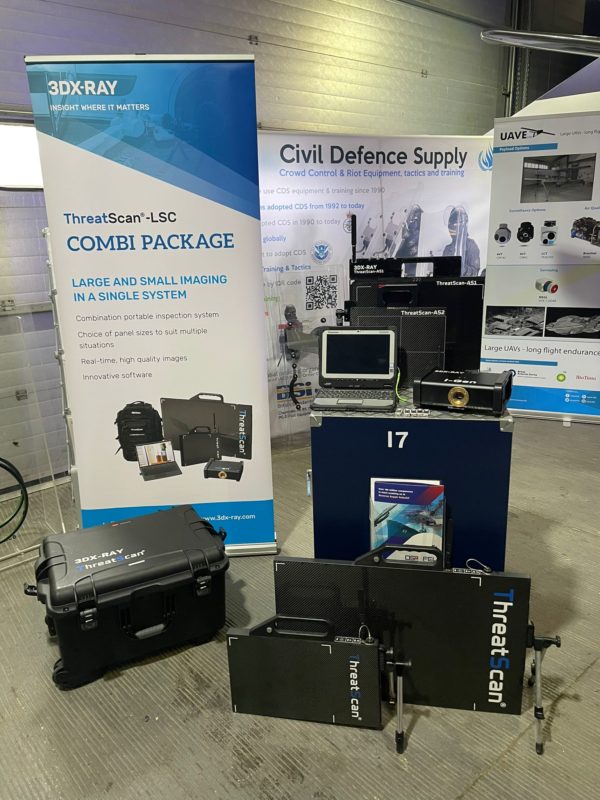
ThreatScan® Series: Purpose-Built for EOD Operations
3DX-Ray’s ThreatScan® Series has been developed specifically for the demanding requirements of EOD operations, combining the imaging performance that technicians require with portability and practicality.
ThreatScan® LS1 provides a large format 600mm × 460mm imaging area and is capable of penetrating up to 40mm steel at 120kV, and up to 60mm at 150kV. The system remains lightweight yet rugged for field deployment.
ThreatScan® LS3 offers a compact 305mm × 256mm imaging area optimised for confined spaces and rapid deployment. Sub-millimetre resolution enables precise component identification even in small devices, making this system ideal for suspicious packages and smaller items where detailed imaging of compact components is essential.
ThreatScan® LSC consists of two panels, the large-format LS1 panel and the compact LS3 panel. This gives operators the ability to choose which would be most suitable depending on the situation.
View all ThreatScan products here
Why These Capabilities Matter in EOD Scenarios
These technical specifications translate directly into positive operational outcomes.
Sub-millimetre resolution identifies small IED components that lower resolution systems might miss, such as a detonator, a small battery, or a thin wire that can change everything about how the explosive should be disposed.
Remote operation maintains safe standoff distances, protecting personnel whilst providing the imaging intelligence they need. Advanced image processing enables the informed render safe decisions on which operator safety depends, and rapid deployment provides immediate assessment capability when every minute matters.
Protecting Lives Through Technology and Expertise
EOD response represents one of the most demanding applications of security technology. The performance of this equipment may directly determine whether personnel return home safely.
Advanced X-ray technology provides the intelligence that transforms dangerous unknowns into manageable, understood threats. For the specialists who face these situations, that intelligence is invaluable.
3DX-Ray’sThreatScan® series has been developed specifically for these demanding applications. These X-rays combine the imaging performance that EOD technicians require with the portability and ease of use that field operations demand.
With decades of expertise in X-ray security technology and systems deployed with law enforcement, military, and specialist units worldwide, 3DX-Ray understands what EOD operations require from their equipment.
Ready to discuss EOD X-ray equipment requirements? Our specialists understand both the technical demands of EOD operations and the procurement considerations that decision-makers face.
We can provide detailed capability information and support throughout the procurement process.