

In 2023 alone, UK police forces and government bodies reported 7,983 suspicious packages, with 40% containing hazardous, dangerous, or illegal items.
The accurate detection of letter bombs is vital in a world that faces increasing unrest and division. Post and delivery services are an easy route for terrorists, not to mention the growing number of hoaxers, campaigners and disgruntled employees, to send harmful packages to others.
Advanced X-ray screening technology provides the essential detection capabilities needed to identify these threats before they can cause harm. In this article, we will explore the types of threats that may be encountered in mailrooms and how the right technology can help you neutralise them fast.
Understanding Mail-Based Threats
Packages of explosive and incendiary devices are as easy to post as a parcel. Letters and packets can hold sharps, blades, offensive materials or hazardous “White Powders.”
Dangerous mail falls into four main categories:
Explosive Devices (Letter Bombs and Package Bombs): Explosive and incendiary devices remain the most catastrophic mail threat. These devices are designed to detonate when envelopes are opened or packages are unwrapped, with mechanisms ranging from simple pressure plates to sophisticated electronic triggers. Modern letter bombs can be very flat and difficult to detect through visual inspection alone, whilst package bombs may be concealed within legitimate-appearing items like books, electronics, or office supplies.
Chemical Threats: Chemical threats encompass toxic substances capable of causing serious injury or death. Contrary to popular terminology, these substances aren’t always “white powders”.
They may be crystalline like sugar, oily or waxy residues, or even liquids. Dangerous chemical agents include ricin (a highly toxic plant-derived poison), nerve agents like sarin, and industrial chemicals repurposed for malicious intent. Even gentle handling of packages containing these substances can release contamination, creating hazards for everyone in the vicinity.
Biological Threats: Biological agents, including anthrax spores, botulinum toxin, and smallpox samples, represent particularly insidious threats because symptoms may not appear immediately after exposure. The 2001 anthrax attacks through the US postal system demonstrated how biological mail threats can terrorise entire populations, infect dozens of people, and disrupt operations at countless facilities, even when most packages prove harmless.
Hoaxes: Hoaxes must be treated with the same seriousness as genuine threats until definitively identified. A suspicious package, whether ultimately dangerous or harmless, triggers the same costly response: evacuation, emergency services deployment, specialist investigation, and operational shutdown.
The financial cost and psychological impact remain identical regardless of the sender’s actual intent. Moreover, treating any suspicious package as potentially harmless creates dangerous precedents that could prove fatal when a genuine threat eventually arrives.
How X-Ray Technology Detects Letter Bombs and Suspicious Packages
Today’s X-ray screening systems often boast advanced materials discrimination technology that goes far beyond simple density imaging.
By analysing how X-rays interact with different materials, these systems provide colour-coded images that make the process of identifying threats intuitive.
Materials discrimination displays organic materials (explosives, chemicals, biological agents, drugs) in orange, inorganic materials (homemade explosives, certain chemical compounds) in green, and metallic objects (weapons, IED components, triggers, batteries) in blue.
This colour-coding enables operators to quickly identify suspicious combinations (such as metallic components (batteries, wires) alongside organic materials (explosives) that could indicate an improvised explosive device).
What X-Ray Screening Can Identify
Using X-ray screening, you can detect:
- Explosive devices and components.
- Chemical and biological threats.
- Sharps, including razors and blades.
- Weapons and firearm components.
- Power sources and triggers for IEDs.
- Contraband, including drugs and prohibited items.
Alongside being able to identify a long list of items, X-ray systems examine package contents in seconds, whilst thorough manual inspection could take minutes per item.
Manual inspection of every incoming item simply isn’t practical at scale, whereas X-ray screening enables comprehensive security without creating stressful bottlenecks.
Choosing the Right X-Ray Security System
Selecting the appropriate screening equipment depends primarily on your organisation’s operational requirements, in particular the volume of mail processed and the physical space that can be made available for screening.
Cabinet Systems for Low to Medium Volume
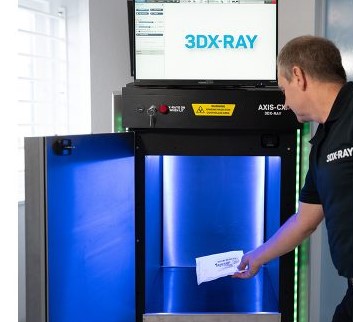
The AXIS™-CXi Cabinet Screening System delivers aviation-standard materials discrimination, the same sophisticated detection technology used in airport security, in a compact format suitable for space-constrained mailrooms.
The spacious 580 × 498 × 688mm inspection chamber accommodates everything from standard letters to cabin-sized bags, eliminating the need for multiple screening passes for larger items. Despite this generous chamber size, the system maintains a compact footprint that fits easily into typical mailroom and reception areas.
The AXIS™-CXi’s Advanced Powder Detection technology specifically addresses “white powder” threats that challenge visual inspection and basic X-ray systems.
The intuitive interface requires minimal operator training whilst still allowing for comprehensive threat detection, making the AXIS™-CXi ideal for corporate mailrooms, government facilities, educational institutions, and any organisation processing moderate mail volumes requiring thorough security screening.
For a demonstration video of the AXIS™-CXi, please click here
Conveyor Systems for High-Volume Operations
AXIS™ Conveyor Systems address the demands of facilities that process substantial quantities of mail where continuous screening throughput is necessary.
The 60cm x 40cm tunnel can accommodate a variety of different item sizes from individual letters to substantial packages, maintaining fast throughput without detection becoming less accurate in the process.
Threat Image Projection (TIP) software provides realistic operator training by inserting simulated threats into actual screening operations, maintaining detection proficiency without taking operators offline for dedicated training sessions.
These conveyor systems prove essential for large courier facilities, central mail processing centres, government mailrooms handling high volumes, and any organisation where continuous screening of 100% of incoming items is required. The systems support individual item screening, batch processing, or complete screening of all incoming mail, depending on individual security requirements.
Compliance: PAS 97:2021
PAS 97:2021 represents the comprehensive UK standard for mail screening and security, developed by the National Protective Security Authority (NPSA) in collaboration with the British Standards Institution (BSI). This specification assists organisations in assessing risks from postal threats and implementing appropriate screening measures.
3DX-Ray systems comply with PAS 97:2021 requirements, meaning that our screening technology meets industry standards and regulatory expectations.
Compliance demonstrates to customers and stakeholders that your organisation follows best practices for mail security, potentially satisfying insurance requirements and regulatory obligations in security-sensitive sectors
For an interview covering Letter bomb security x-ray please click here
Protecting Your Mailroom from Letter Bombs
Every package that passes through your mailroom represents a potential security risk. This isn’t to suggest that these threats are common, but the consequences when they do occur can be catastrophic if organisations don’t take measures to prepare.
Professional X-ray screening systems provide the detection necessary to identify concealed explosives or dangerous substances that may otherwise reach your staff undetected. They maintain consistent performance regardless of volume, operator experience, or time pressure
The investment in X-ray screening equipment is modest compared to the potential cost of a single serious incident, and negligible compared to the value of your employees’ safety.
Assess your mailroom security today. Our experts can evaluate your current processes, identify and recommend screening solutions that provide protection without disrupting your operations.